Introduction
India’s growing energy demand and the need for sustainable waste management have created significant opportunities in the Compressed Biogas (CBG) sector. Agricultural residues, cattle dung, and organic waste can be converted into a cleaner gaseous fuel, supporting the circular economy while creating new business opportunities.
The SATAT (Sustainable Alternative Towards Affordable Transportation) initiative, launched in 2018, was introduced to encourage the production and use of CBG as an alternative fuel and to develop a broader ecosystem connecting CBG producers with potential buyers and end users.
The Challenge: Waste Management and Energy Demand
India generates substantial quantities of agricultural, animal, and organic waste. When inadequately managed, this waste can contribute to environmental pollution and the inefficient use of valuable resources.
At the same time, the country is working to diversify its energy sources, increase domestic fuel production, and develop cleaner alternatives for transportation and industrial applications.
The opportunity lies in converting these waste streams into commercially useful energy through appropriate technology, infrastructure, and market linkages.
The SATAT Approach: Converting Waste into Fuel
SATAT promotes an ecosystem in which entrepreneurs and project developers establish CBG plants and supply the resulting fuel for suitable applications.
The CBG production process
Organic Feedstock → Biogas Production → Purification → Compression → CBG Supply
The process generally involves:
- Feedstock collection: Agricultural residues, cattle dung, and suitable organic or industrial waste are collected.
- Biogas production: Organic material undergoes anaerobic digestion to generate biogas.
- Gas purification: Carbon dioxide, moisture, hydrogen sulphide, and other impurities are reduced as required to meet the applicable gas-quality specifications.
- Compression and storage: The purified biomethane is compressed and stored using suitable high-pressure equipment.
- Distribution and utilization: CBG is transported or supplied through appropriate infrastructure for transportation, industrial, and other permitted gas applications.
Project Development: Who Can Participate?
CBG projects can be developed by private entrepreneurs, companies, cooperatives, and other eligible entities, subject to the relevant scheme conditions, approvals, and regulatory requirements.
A typical project developer is responsible for coordinating:
- Land and statutory approvals.
- Feedstock availability and supply-chain management.
- Project financing and commercial planning.
- Digestion, upgrading, and compression technologies.
- Plant engineering, procurement, and construction.
- Gas quality compliance, storage, and transportation.
- Plant operations, maintenance, and product marketing.
Project viability depends on factors such as feedstock consistency, plant capacity, technology selection, capital costs, operating expenses, gas offtake arrangements, and applicable government support.
Enabling the CBG Ecosystem
The growth of CBG depends on more than the production plant itself. Commercial success requires coordination among producers, equipment suppliers, gas buyers, financial institutions, infrastructure providers, and government agencies.
Depending on eligibility and current programme guidelines, relevant support mechanisms may include:
- CBG offtake and procurement arrangements.
- Priority Sector Lending for eligible projects.
- Capital or financial assistance under applicable government programmes.
- Biomass aggregation and feedstock supply-chain support.
- Pipeline connectivity and integration with CGD networks.
- Support for the utilization and marketing of organic manure.
Government initiatives, including the GOBARdhan framework and other applicable programmes, can contribute to sector development. However, the specific benefits, eligibility criteria, funding limits, and implementation conditions must be verified against the latest official guidelines.
Business Opportunities Across the Value Chain
As CBG infrastructure develops, demand can arise across multiple technical and commercial disciplines.
| Sector | Potential Opportunities |
|---|---|
| Plant Engineering | Process design and engineering services |
| EPC & Construction | Plant development and turnkey execution |
| Equipment Manufacturing | Compressors, cascades, dispensers, and storage systems |
| Gas Analysis | Biogas analysers and gas-quality monitoring |
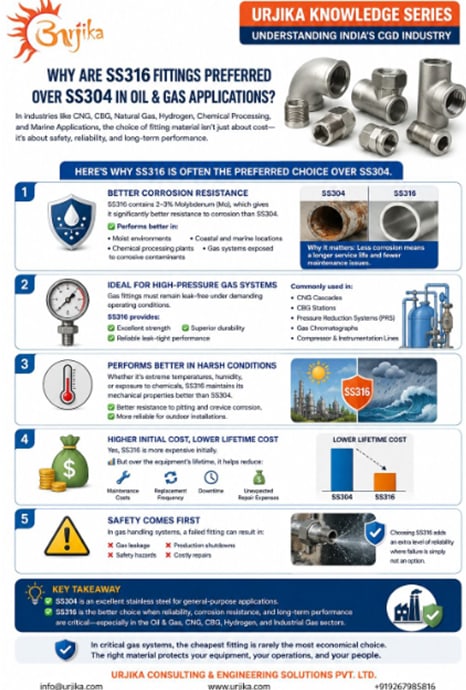
| High-Pressure Systems | Manifolds, tubing, fittings, and piping |
| Transportation & Logistics | Biomass collection and CBG distribution |
| Installation & Commissioning | Equipment integration and site execution |
| Operations & Maintenance | Plant reliability and lifecycle support |
| Sales & Business Development | Equipment sales, project development, and customer acquisition |
Career Opportunities in the CBG Sector
The CBG industry creates opportunities for professionals from engineering, operations, sales, marketing, logistics, finance, and project management backgrounds.
Emerging areas of professional involvement include:
- Mechanical, chemical, and process engineering.
- Instrumentation, automation, and electrical systems.
- High-pressure gas handling and equipment maintenance.
- Quality control and gas analysis.
- Procurement and supply-chain management.
- Project execution and commissioning.
- Technical sales and business development.
- Environmental management and sustainability.
For professionals entering the sector, understanding the complete value chain—from feedstock and gas production to compression, storage, transportation, and end use—can be a valuable career advantage.
The Role of Urjika in the CBG Ecosystem
Urjika Consulting & Engineering Solutions Pvt. Ltd. operates in the CNG, CBG, and clean energy infrastructure space, supporting project requirements through equipment supply and engineering services.
Relevant areas of involvement include:
- CBG compressors and high-pressure gas systems.
- CBG storage cascades and associated equipment.
- CBG dispensers and LCV fill posts.
- Odorizer systems and biogas analysis equipment.
- High-pressure manifolds, tubing, and fittings.
- Equipment installation, commissioning, and project execution support.
These capabilities support the infrastructure required to connect gas production, storage, and distribution systems.
Conclusion: Turning Waste into Opportunity
SATAT helped bring national attention to the potential of CBG as a transport fuel and encouraged the development of a broader waste-to-energy ecosystem. Continued growth will depend on commercially viable projects, reliable feedstock supply, suitable technology, infrastructure connectivity, regulatory compliance, and sustainable offtake arrangements.
The CBG opportunity extends beyond fuel production. It encompasses equipment manufacturing, engineering services, project execution, logistics, operations, and skilled employment.
Waste → Energy → Infrastructure → Business → Employment
As India’s clean energy ecosystem evolves, CBG can become an important part of the country’s efforts to improve waste utilization, diversify energy sources, and build new industrial capabilities.