Introduction
India’s oil and gas industry relies on a combination of safety oversight, technical standards, and regulatory frameworks to support the safe development and operation of petroleum and natural gas infrastructure.
Three important organizations frequently encountered in this sector are PESO, OISD, and PNGRB. Although their responsibilities may intersect in certain projects, each has a distinct role.
Understanding these differences is essential for freshers, engineers, project managers, equipment manufacturers, EPC contractors, and professionals working in CNG, CBG, LNG, and City Gas Distribution (CGD).
The Challenge: Understanding Different Compliance Requirements
During the development of a CNG station, CBG facility, gas storage installation, or pipeline network, companies must consider multiple technical and regulatory requirements.
Confusion can arise because different authorities and standards may apply to the same project. For example, an installation may require statutory approvals for equipment and storage, adherence to applicable safety standards, and compliance with regulations governing the relevant gas infrastructure.
Understanding which organization performs which function helps project teams plan approvals, select suitable equipment, and manage safety requirements more effectively.
The Three Key Organizations
PESO — Petroleum and Explosives Safety Organisation
Primary role: Statutory safety regulation and licensing for specified hazardous substances and equipment.
PESO operates under the Department for Promotion of Industry and Internal Trade (DPIIT), Government of India. Its responsibilities include administering applicable laws and rules relating to explosives, petroleum, and specified compressed gases and related equipment.
Its work may be relevant to:
- Compressed gas storage and handling installations.
- CNG/CBG cascades and gas cylinders.
- Pressure vessels and other regulated equipment.
- Petroleum storage and handling facilities.
- Applicable approvals, licences, and safety requirements.
Practical example: A company manufacturing or installing a compressed gas cascade must determine the applicable statutory approval, licensing, and compliance requirements based on the equipment type, intended use, and installation.
Think of PESO as the statutory safety and licensing authority for the areas covered by its mandate.
OISD — Oil Industry Safety Directorate
Primary role: Developing safety standards and recommended practices for the oil and gas industry.
OISD functions under the Ministry of Petroleum and Natural Gas and develops safety standards and guidance for petroleum and natural gas installations.
Its work supports safe design, construction, operation, inspection, maintenance, and emergency preparedness across relevant facilities.
Key areas include:
- Oil and gas processing installations.
- Petroleum storage terminals and depots.
- Pipelines and related facilities.
- Fire prevention and protection.
- Operational safety and risk management.
- Inspection and maintenance practices.
Practical example: During the design or modification of a petroleum or gas facility, the project team may need to identify and apply relevant OISD standards where required by the applicable regulatory framework, approvals, or contractual requirements.
Think of OISD as a developer of industry safety standards and recommended practices.
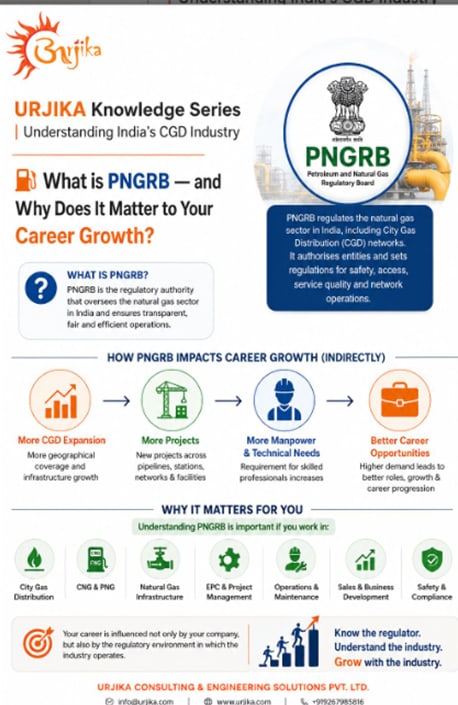
PNGRB — Petroleum and Natural Gas Regulatory Board
Primary role: Regulating specified downstream petroleum and natural gas activities and infrastructure.
PNGRB is a statutory regulatory board established under the Petroleum and Natural Gas Regulatory Board Act, 2006.
Its responsibilities include regulating specified activities such as natural gas pipelines, City Gas Distribution networks, and petroleum product pipelines within its statutory mandate.
Its work is particularly relevant to:
- City Gas Distribution (CGD) networks.
- Compressed Natural Gas (CNG) infrastructure within the applicable regulatory framework.
- Piped Natural Gas (PNG) networks.
- Natural gas pipeline infrastructure.
- Petroleum product pipeline infrastructure.
- Applicable technical and safety regulations for regulated entities and installations.
Practical example: A company developing a CGD network must consider the relevant PNGRB authorizations, regulations, and technical requirements applicable to its geographical area and infrastructure.
Think of PNGRB as the downstream petroleum and natural gas infrastructure regulator within its statutory jurisdiction.
PESO vs OISD vs PNGRB: Key Differences
| Parameter | PESO | OISD | PNGRB |
|---|---|---|---|
| Full form | Petroleum and Explosives Safety Organisation | Oil Industry Safety Directorate | Petroleum and Natural Gas Regulatory Board |
| Core function | Statutory safety oversight, approvals and licensing in its domain | Safety standards and recommended practices | Regulation of specified downstream gas and petroleum infrastructure |
| Main focus | Regulated hazardous substances, equipment and installations | Industry safety and operational practices | Pipelines, CGD and other regulated downstream activities |
| Typical relevance | Cascades, cylinders, compressed gas storage | Facility design, operation, fire safety and maintenance | CGD networks, CNG infrastructure and gas pipelines |
| Nature of role | Statutory authority | Standards and safety guidance body | Statutory regulatory board |
Important: These roles are not interchangeable. The exact legal requirements depend on the equipment, installation, activity, applicable regulations, and project circumstances. OISD standards may also become mandatory where incorporated into applicable requirements.
How They Relate to a CNG/CBG Project
Consider a project involving a gas storage cascade and its connection to a CNG/CBG facility.
The project team would typically need to:
- Identify applicable statutory requirements: Determine which PESO approvals, licences, or other statutory permissions apply to the equipment and installation.
- Review relevant safety standards: Identify applicable OISD standards and other required technical codes or practices.
- Check infrastructure regulations: Determine whether PNGRB authorizations and regulations apply to the relevant pipeline, CGD network, or other regulated activity.
- Complete engineering and installation: Ensure equipment selection, high-pressure connections, installation, and commissioning meet the applicable technical and safety requirements.
- Maintain compliance records: Keep relevant approvals, inspection records, test documentation, and commissioning records as required.
The exact approval pathway should be established during project planning rather than assumed to be identical for every CNG or CBG installation.
Why This Knowledge Matters for Freshers
Understanding PESO, OISD, and PNGRB helps new professionals communicate more effectively with clients, consultants, contractors, and regulatory stakeholders.
It is particularly useful for people working in:
- Mechanical and process engineering.
- Equipment manufacturing and quality assurance.
- CNG/CBG cascade and compressor sales.
- High-pressure tubing and piping projects.
- EPC, installation, and commissioning.
- CGD operations and project management.
- Technical sales and business development.
For example, a technical sales professional supplying a cascade should understand the relevant equipment approval requirements, while a project engineer working on a gas pipeline must also identify the applicable pipeline regulations and technical standards.
The Role of Urjika in CNG/CBG Infrastructure
Urjika Consulting & Engineering Solutions Pvt. Ltd. supports the CNG, CBG, and clean energy sectors through equipment supply and engineering services.
Its relevant product and service areas include:
- CNG/CBG storage cascades.
- Compressors and gas handling equipment.
- CBG dispensers and LCV fill posts.
- Odorizer systems and gas analysers.
- High-pressure manifolds, tubing, and fittings.
- Equipment installation, commissioning, and project execution.
Understanding the relevant regulatory and safety framework helps project teams identify applicable requirements and plan equipment supply and engineering work accordingly.
Conclusion
PESO, OISD, and PNGRB contribute to India’s oil and gas ecosystem through different but complementary functions.
- PESO: Statutory safety oversight and licensing within its mandate.
- OISD: Industry safety standards and recommended practices.
- PNGRB: Regulation of specified downstream petroleum and natural gas infrastructure.
For professionals entering the CNG, CBG, LNG, or CGD sectors, understanding these distinctions provides a useful foundation for working on projects involving equipment, pipelines, storage, and gas distribution.