Introduction
For hotels, commercial kitchens, industrial facilities, and remote project sites, maintaining a reliable fuel supply is essential for uninterrupted operations.
Traditional LPG supply chains can involve scheduled deliveries, tanker or cylinder logistics, storage constraints, and exposure to changing fuel prices. For businesses operating in locations with limited infrastructure or fluctuating fuel demand, these challenges can affect operational planning.
Mobile compressed gas infrastructure offers another approach. A compact, trolley-mounted cascade system can store compressed gas and supply it through a suitable pressure-regulation arrangement, subject to site requirements and applicable approvals.
This case study explores how Urjika’s 100 WL Vertical Cascade System could support flexible fuel logistics for suitable commercial and industrial applications.
The Challenge: Dependence on Conventional Fuel Logistics
Consider an illustrative commercial kitchen or hospitality facility that relies on regular LPG deliveries.
The facility faces several operational challenges:
- Supply dependency: Cooking and heating operations rely on timely fuel replenishment.
- Storage limitations: Available space may restrict the installation of conventional bulk storage infrastructure.
- Operational disruptions: Delivery delays can create pressure to maintain adequate backup fuel.
- Cost uncertainty: Fuel prices and transportation charges can affect operating budgets.
- Remote-site constraints: Temporary facilities and remote locations may lack convenient access to established fuel infrastructure.
These challenges encourage businesses to evaluate alternative fuel arrangements that offer greater flexibility without compromising safety or reliability.
The Proposed Solution: Urjika 100 WL Vertical Cascade System
Urjika’s proposed solution is a compact, trolley-mounted high-pressure cascade designed for mobile gas storage and controlled gas delivery.
The system combines high-pressure cylinders with a suitable decompression or pressure-regulation unit to provide gas at a lower downstream pressure for compatible applications.
Technical specifications provided for this case study:
| Parameter | Specification |
|---|---|
| Configuration | 50 WL × 2 cylinders |
| Total water capacity | 100 WL |
| Working pressure | 250 bar |
| Approximate gas storage capacity | 20 kg |
| Pressure-regulation system | Integrated DCU |
| Stated output pressure | 2–4 bar |
| Approximate system weight | 200 kg |
| Design | Compact, vertical, trolley-mounted |
Specifications are based on the supplied product description. Actual gas capacity, usable delivery quantity, output pressure, dimensions, and total weight should be confirmed against the approved product datasheet and operating conditions.
How the System Works
The system follows a basic compressed-gas supply arrangement:
- Gas storage: Compatible CNG or BioCNG is stored in approved high-pressure cylinders.
- Pressure reduction: An appropriately designed decompression unit reduces the pressure to the required downstream operating range.
- Controlled delivery: Gas is supplied to compatible equipment through a correctly designed and protected connection.
- Replenishment or cylinder exchange: The system is replenished or exchanged through an approved supply arrangement when the usable gas inventory reaches its operating limit.
The downstream equipment, pipework, ventilation, gas detection, isolation, and emergency shutdown provisions must be suitable for the particular application.
A system described as mobile is not automatically suitable for operation at every location. Site conditions, installation requirements, transportation rules, and applicable safety approvals must be assessed before deployment.
Illustrative Case Study: A Commercial Kitchen Seeking Fuel Flexibility
Imagine a hotel or commercial kitchen that wants to reduce its dependence on scheduled LPG deliveries and assess an alternative gas supply arrangement.
The engineering team evaluates a mobile cascade system against the site’s fuel demand, appliance requirements, storage area, and replenishment options.
Step 1 — Assess fuel demand
The team determines daily gas consumption, peak demand, operating hours, and the consequences of a supply interruption.
Step 2 — Verify equipment compatibility
The existing LPG burners and regulators cannot simply be connected to a CNG or BioCNG system. The kitchen must use equipment specifically designed or approved for the proposed gas, with suitable pressure regulation and safety controls.
Step 3 — Evaluate storage and logistics
The team checks whether the proposed system’s usable gas inventory can meet the required operating period, accounting for replenishment time, residual gas, and actual demand.
Step 4 — Complete the safety and compliance review
Qualified personnel assess the installation, gas connections, ventilation, leak detection, emergency isolation, cylinder handling, and all applicable statutory and site requirements.
Step 5 — Compare operating economics
The business compares the delivered cost of usable energy, equipment and installation costs, maintenance, replenishment logistics, and any appliance-conversion costs.
The system is considered viable only if it meets the site’s technical, operational, safety, and commercial requirements.
This is an illustrative scenario, not a report of an actual customer installation or verified cost savings.
Potential Business Benefits
When properly designed and deployed, a mobile cascade system may offer several advantages:
Compact infrastructure
A vertical arrangement can help make use of limited floor space, subject to required clearances and safe access.
Deployment flexibility
A trolley-mounted design may simplify movement and handling within approved operating environments.
Alternative fuel logistics
Where a dependable CNG or BioCNG supply chain exists, the system may provide an alternative to some conventional LPG delivery arrangements.
Controlled gas delivery
A suitable DCU or pressure-regulation assembly can help deliver gas within the specified downstream pressure range.
Support for cleaner-energy objectives
BioCNG produced from suitable renewable feedstocks can support waste-to-energy initiatives and potentially reduce lifecycle greenhouse-gas emissions compared with fossil fuels, depending on the production pathway and methane management.
Important: These benefits are application-dependent. Lower operating costs, uninterrupted supply, and reduced logistical dependency must be demonstrated through a site-specific assessment rather than assumed.
Key Engineering and Compliance Considerations
Before deploying a mobile high-pressure gas system, businesses should verify the following:
- Gas compatibility: Confirm that the supplied gas meets the relevant specification and is suitable for the intended equipment.
- Usable capacity: Distinguish total stored gas from the quantity deliverable at the required pressure and under actual operating conditions.
- Pressure control: Confirm that the regulator, DCU, downstream piping, and protective devices are suitable for the design conditions.
- Appliance compatibility: LPG appliances must not be connected directly without an approved technical solution.
- Cylinder handling: Ensure approved cylinders, secure mounting, suitable connections, and safe transport and exchange procedures.
- Site safety: Assess ventilation, gas detection, ignition sources, access, isolation, and emergency response.
- Regulatory requirements: Verify all applicable permissions, installation requirements, transport rules, and approvals with the relevant authorities and qualified professionals.
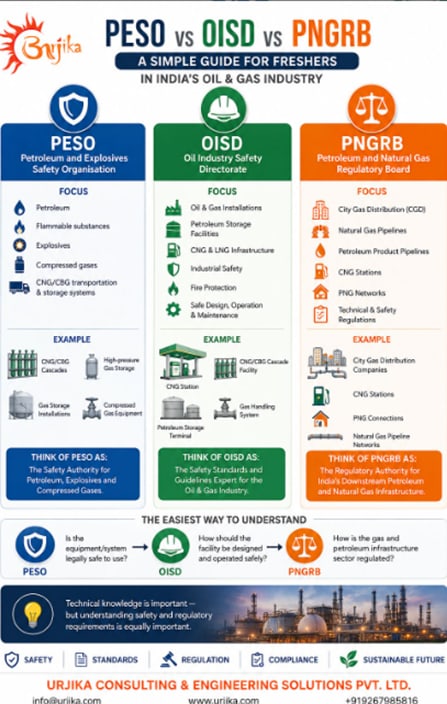
Regulatory note: A claim that a system requires no PESO licence solely because its gas capacity is below a particular threshold should not be relied upon without checking the current rules and the specific installation. Applicability can depend on the equipment, gas quantity, storage arrangement, location, and relevant exemptions or conditions.
Why This Matters for Urjika
At Urjika Consulting & Engineering Solutions Pvt. Ltd., mobile cascade systems represent one potential approach to flexible gas infrastructure for suitable commercial and industrial applications.
The solution brings together high-pressure storage, decompression, gas connections, and application-specific installation requirements. Each element must be evaluated as part of the complete system to support safe, reliable operation.
For businesses considering CNG or BioCNG, the right decision begins with understanding actual fuel demand, supply availability, downstream equipment, compliance obligations, and total operating cost.
Key Takeaways
- Mobile cascade systems can offer flexible compressed-gas storage and delivery where suitable infrastructure and supply arrangements exist.
- A 100 WL system with a stated storage capacity of approximately 20 kg should be evaluated using its verified usable gas capacity and actual demand.
- LPG and CNG/BioCNG require different storage and combustion arrangements; existing LPG equipment is not automatically compatible.
- Fuel savings and supply reliability depend on the complete logistics chain and site-specific economics.
- Safety engineering and regulatory verification are essential before installation or deployment.
- Mobile gas infrastructure can complement existing fuel arrangements, but it is not a universal replacement for LPG tankers or conventional gas supply systems.
Conclusion
The future of commercial fuel supply will not be defined by storage capacity alone. It will depend on choosing the right combination of fuel, equipment, logistics, and safety controls for each application.
A compact mobile cascade may provide a practical option for businesses that need flexible compressed-gas supply, provided the solution is technically suitable, commercially viable, and compliant with applicable requirements.